Chain Abstraction and the End of the Multi-Wallet Problem
The average crypto user manages 3+ wallets across different chains. Chain abstraction aims to make that unnecessary. After years of building for Web3 onboarding, I think this is the most important UX problem the industry needs to solve.
Chain Abstraction and the End of the Multi-Wallet Problem
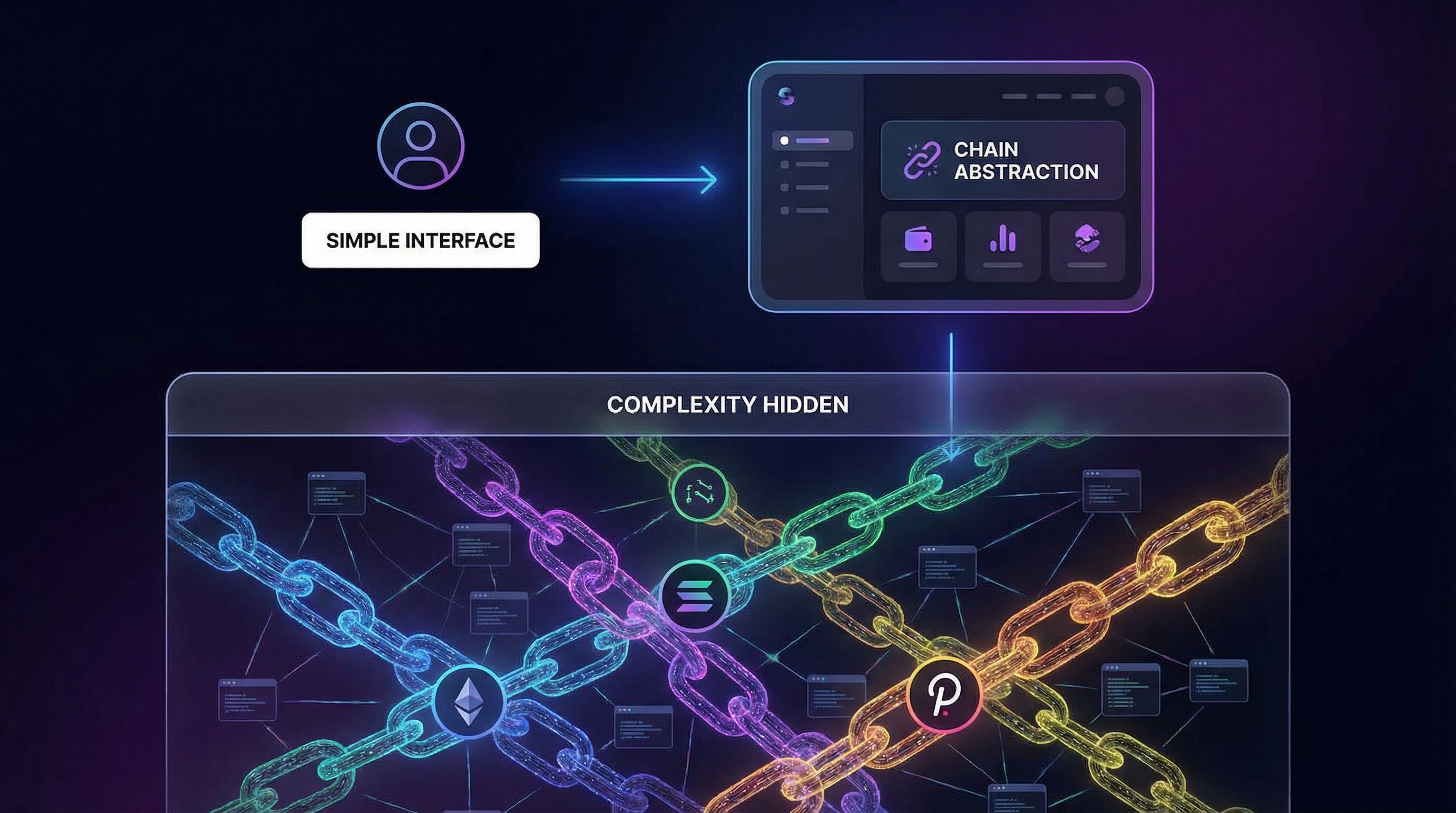
Ask any non-crypto person to try using a decentralized application. Within ten minutes, they'll hit a wall that has nothing to do with the application itself: "Which chain am I on? Why do I need a different token for gas? Why can't I use the USDC I have on Ethereum in this app on Arbitrum?" These aren't edge cases — they're the default experience. And after years of working on Web3 onboarding, first through developer tools and then through wallet infrastructure, I'm convinced that chain abstraction is the single most important UX challenge our industry needs to solve.
The Problem Is Worse Than We Admit
If you're deep in crypto, you've normalized an absurd amount of complexity:
- Multiple wallets or accounts across EVM chains, Solana, Cosmos, and others
- Bridge anxiety — moving assets between chains through third-party bridges, hoping nothing goes wrong during the process
- Gas token management — needing ETH on Ethereum, AVAX on Avalanche, SOL on Solana, just to pay transaction fees
- Asset fragmentation — your net worth scattered across a dozen chains with no unified view
- Cognitive overhead — mentally tracking which assets are on which chain, which bridges are safe, and which RPC you need
We've been telling ourselves this complexity will be "abstracted away" for years. In 2025, it's finally starting to happen.
What Chain Abstraction Actually Means
Chain abstraction is the idea that users should interact with applications without needing to know or care which blockchain they're on. The user has one account, one balance view, and when they want to do something — swap a token, mint an NFT, provide liquidity — the infrastructure handles the routing, bridging, and gas management behind the scenes.
This requires solving several hard problems simultaneously:
Unified accounts. One identity and one set of keys that works across all chains. ERC-4337 (account abstraction) on EVM chains is a foundational piece, but cross-chain identity is the bigger challenge.
Intent-based execution. Instead of specifying exact transactions ("swap 1 ETH for USDC on Uniswap V3 on Arbitrum using 0.001 ETH for gas"), you express intents ("swap 1 ETH for USDC at the best available rate"). Solvers compete to fulfill your intent optimally across available venues and chains.
Gas abstraction. Pay gas in any token, or don't think about gas at all. Paymasters (an ERC-4337 concept) allow applications or third parties to sponsor gas fees on behalf of users.
Cross-chain messaging. Reliable, fast communication between chains for asset transfers and contract calls.
The Players and Their Approaches
Several teams are attacking chain abstraction from different angles:
Account-Level Abstraction
- Particle Network is building a Universal Account layer that aggregates balances across chains into a single account
- NEAR Protocol has been pushing chain signatures that allow a NEAR account to sign transactions on any chain
- Safe (formerly Gnosis Safe) is extending their smart account infrastructure across chains
Intent-Based Systems
- Across Protocol and UniswapX are pioneering intent-based bridge and swap systems where users express what they want and solvers figure out how
- Anoma is building an intent-centric architecture from the ground up
Infrastructure-Level
- Avalanche's Warp Messaging and Teleporter enable native cross-chain communication between Avalanche L1s without external bridges
- Chainlink CCIP provides generalized cross-chain messaging with oracle-backed security
- LayerZero offers omnichain messaging with configurable security models
My Experience: What Users Actually Need
Working on Coinbase's CDP Wallets earlier this year gave me a front-row seat to what mainstream users actually need from wallet infrastructure. The answer is surprisingly simple: they need to not think about infrastructure at all.
The most successful Web2 applications don't ask users which server their data is stored on. They don't require users to manage API keys or understand HTTP. Web3 needs to reach that same level of abstraction. When I talk to developers building consumer applications, the number one request is: "make the blockchain invisible to my users."
This isn't about dumbing things down. Power users should still be able to choose specific chains, optimize for gas costs, or control their own key management. But the default experience — the one a new user encounters — should be chainless.
The Technical Challenges
Chain abstraction is hard because it requires coordination across multiple trust domains:
Latency
Cross-chain operations introduce latency. A swap that takes 2 seconds on a single chain might take 30 seconds when it involves bridging. Intent-based systems help by allowing solvers to front the liquidity, but this introduces MEV and solver centralization concerns.
Security
Every abstraction layer is a potential attack surface. Bridges have historically been the most exploited component in Web3 (Wormhole, Ronin, Nomad). Chain abstraction solutions that minimize bridging — like native cross-chain messaging on Avalanche — have a structural security advantage.
State Consistency
When a user's state is spread across multiple chains, ensuring consistency becomes complex. What happens if a cross-chain transaction partially fails? How do you handle reverts that span multiple chains?
Cost
Abstraction has a cost. Someone has to pay for the gas on the destination chain, the solver has to be compensated for taking on bridging risk, and the infrastructure itself has operational costs. The question is whether these costs can be made low enough to be invisible.
Where I Think This Is Going
My prediction: within two years, the leading consumer crypto applications will offer a fully chain-abstracted experience. Users will have a single account, see a unified balance, and transact across chains without awareness of the underlying infrastructure. The applications that don't offer this will feel as dated as websites that require users to choose a specific server.
The chains that win will be the ones that make abstraction native rather than bolted on. Avalanche's approach — native cross-chain messaging between L1s, shared security through the Primary Network — is well-positioned here. So is Cosmos's IBC ecosystem.
For developers, the implication is clear: start building with chain abstraction in mind now. Don't hardcode chain assumptions. Use intent-based patterns. Design UX flows that work regardless of which chain the user's assets are on.
The multi-chain future is inevitable. The multi-wallet present is not. Chain abstraction is how we bridge the gap, and the projects solving it today are building the infrastructure for the next billion Web3 users.